
Illustrative situation. A contract start date moved from 1 October to 1 November. Finance has updated the forecast. The revised number is correct, and the room has gone quiet, because nobody has said what the business will do about it.
A board absorbs a changed number quickly. It cannot absorb one with no visible owner and no decision attached.
What the board is actually asking for
Three things, in this order.
A traceable assumption: what changed, on what evidence, confirmed by whom.
Linked consequences: what it does to revenue timing, committed capacity, and separately to cash.
An accountable response: what management proposes to do, who owns it, and when it is reviewed.
Conversations stall because the first is missing, so the other two cannot be defended.
The movement, worked through
Illustrative example. One 12-month service contract at £80,000 per complete month, recognised evenly as delivered. Planned start 1 October, revised start 1 November. The full term shifts by one month. The fee and monthly recognition are unchanged.
Q4 revenue (£) Original Revised Movement
| October | 80,000 | 0 | - 80,000 |
| November | 80,000 | 80,000 | 0 |
| December | 80,000 | 80,000 | 0 |
| Q4 total | 240,000 | 160,000 | -80,000 |
Nothing has been lost. One month of revenue has moved beyond the quarter, and the contract runs its full term at the same fee.
Two things this table does not tell you. It says nothing about cost, because no cost assumptions are specified. And it says nothing about cash, which needs its own inputs: the invoice schedule, payment terms and collection profile. A revenue timing movement is not a cash movement until those are applied.
Three records, three different jobs
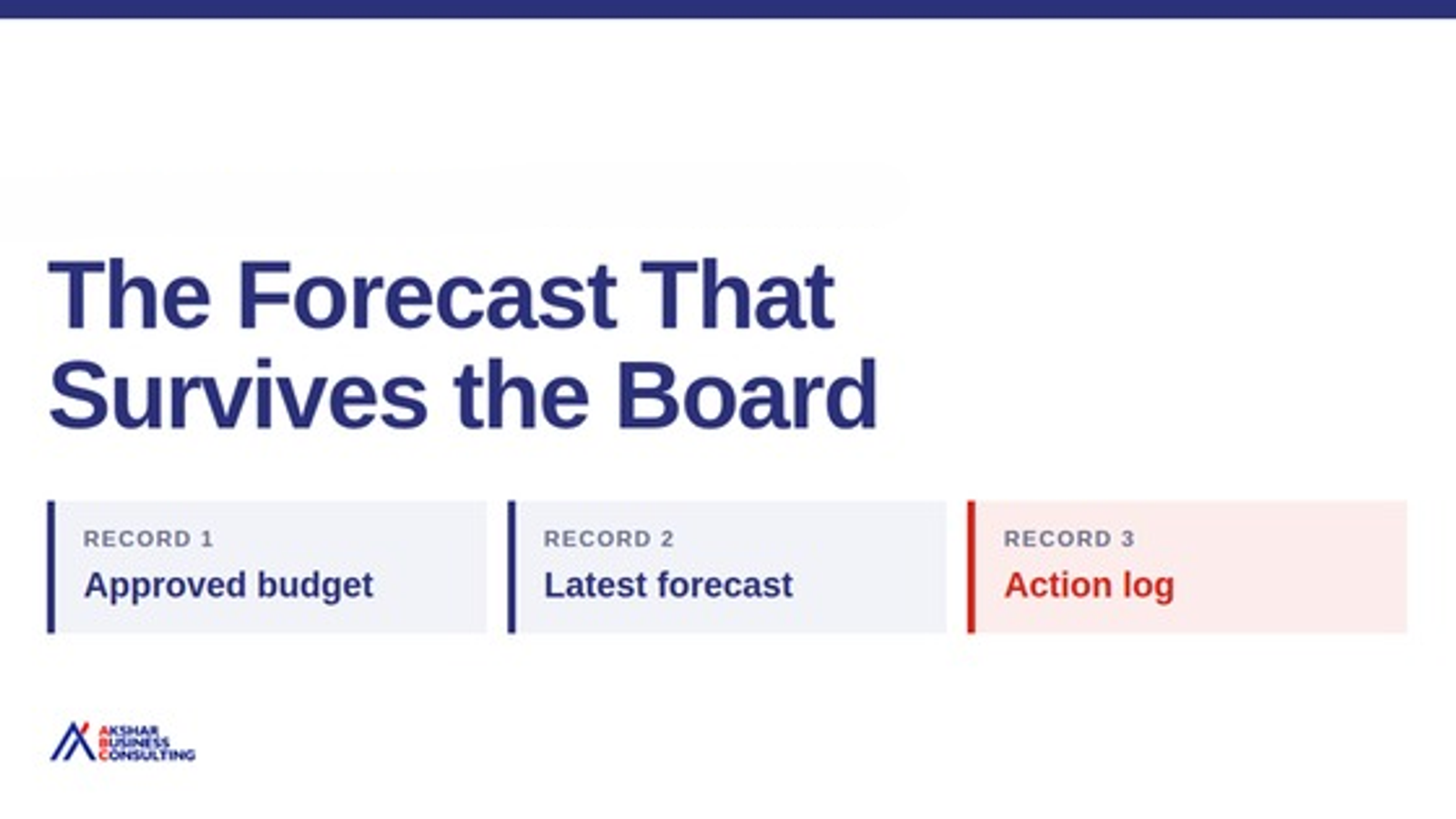
The approved budget stays exactly as approved. It is the commitment baseline, and quietly editing it removes the only fixed point the board can measure against.
The latest forecast changes, because it is an expectation rather than a promise. Holding it still to protect a number is how a forecast stops being useful.
The action log records the management response: the capacity decision, revised recruitment timing, the conversation with the customer. It belongs in its own record, because a decision is not an assumption.
In a 2026 research discussion, a finance leader in a payments business described linking monthly results to the implications for the rest of the year, and holding leaders accountable for budgets and forecasts. That observation is theirs; the three-record structure is my proposed design.
The capacity choice this creates
The revenue has moved. The team, the contracted capacity and the service obligations have not.
So the question is whether that capacity can be redeployed. If viable alternative work exists, the assessment is contribution and delivery risk. If not, it is the cost of holding capacity against the obligations you still carry.
Neither branch produces an automatic saving. Both require somebody to choose.
A finance leader at a technology business described budgets committed to projects that did not happen, preventing other initiatives being funded. Committed capacity behaves the same way. It is only free once a decision releases it.
A decision record that fits on one screen
Five entries, no more.
The changed assumption and its effective date. Start date 1 October to 1 November.
The evidence, its source and the date captured. Customer confirmation, source record amended 29 September.
The forecast version that now contains it. Named, so the movement can be found again later.
Validation. The commercial owner confirms the start date, operations validates capacity, finance updates the authorised financial consequences.
The options, the approver and the next review. Approver set by materiality.
A proposed example rather than a universal policy: where a delay exceeds 10 working days, review capacity before making the next delivery commitment. Set your own threshold. The value is in having one.
Where the approval should sit
Traceability fails two ways. With no approval route, assumptions change invisibly. With every change routed to the CFO, the process becomes a queue and people work around it.
Materiality is the dividing line. A start date that moves a quarter deserves a named approver. A minor phasing correction does not. Set the threshold once, in advance.
Connect those records to the source data underneath and a board can interrogate the number in the meeting, not after it. Trusted data, responsive planning, up-to-date insights and engaged decision support are the standard this serves, not a product you buy.
What I have come to think
The forecasts that survive a board meeting are rarely the most accurate. They are the ones where somebody can explain, without leaving the room, what changed, who confirmed it and what is being done. Accuracy matters, but defensibility decides whether the board trusts the next forecast you bring. My own judgement has shifted: I used to think the modelling was the hard part, and I now think it is deciding in advance who may change an assumption and who has to know.
Which part is hardest to defend in your forecast: the assumption, the consequence or the management response?