
In most PE-backed businesses I work with, the numbers in the board pack are right. The trouble is everything around them: a story that's hard to follow, a pack that takes too long to produce, and KPIs that don't connect to the plan the sponsor is backing.
In an investor-backed business, those gaps cost more than time. A pack that lands late, or needs a cover note to explain it, weakens confidence in Finance at exactly the moment the board needs to rely on it.
Why board reporting carries more weight under PE ownership
In a founder-led business, a weak board pack is an irritation. Under PE ownership, it shapes how the sponsor sees the whole finance function. The board pack is the main window the sponsor has into the business between visits, and it's often the first thing a new chair or operating partner reads.
Every month it answers a quiet question: can this team be trusted with the plan? A pack that reconciles, explains its movements and looks forward builds that trust over the holding period. A pack that needs translating erodes it, even when every number in it is right.
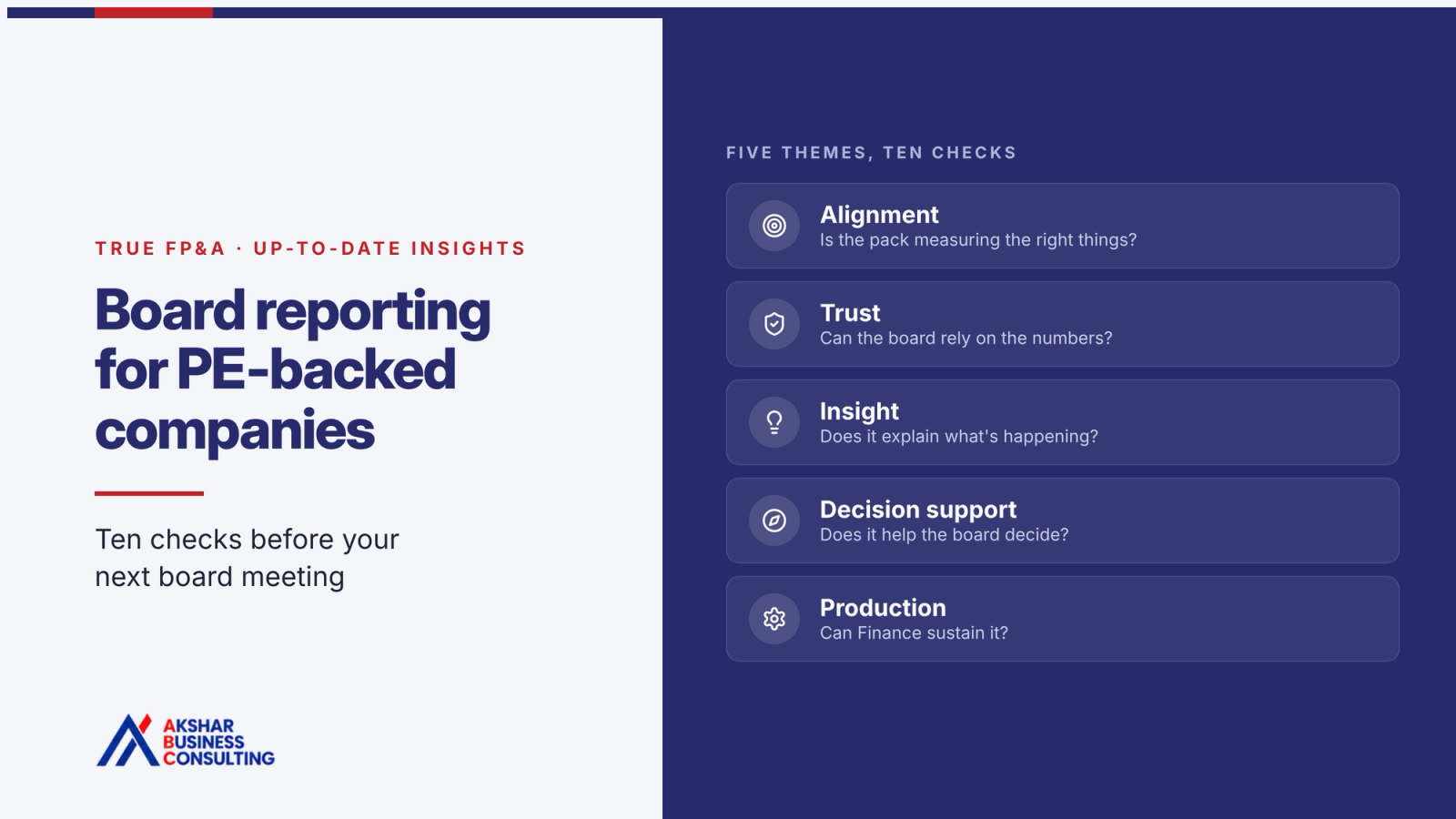
These are the ten checks I use to judge whether board reporting is investor-grade. They're the same ten in our Board Pack Health Check, grouped here into five themes. Run through them before your next board meeting.
Alignment: is the pack measuring the right things?
1. Investment thesis alignment
KPIs should link clearly to the value creation plan and the board's priorities. If a measure predates the current owner and nobody can say which part of the plan it tracks, it belongs in an appendix, or nowhere. I wrote a step-by-step guide to value creation plan KPIs if you're rebuilding the set.
2. Focused KPIs
Outcome, driver and control KPIs should each be clear, owned and consistent. A long list of outcomes tells the board where the business landed, without showing what's moving the result or how far the numbers can be relied on.
Trust: can the board rely on the numbers?
3. One version of the truth
Numbers should reconcile across finance, operations and leadership reporting. If revenue in the pack differs from revenue in the sales report, the board's first question will be which one is right. In our 2025 FP&A Reality Gap research, 15 of the 19 finance leaders we interviewed did not have a true single source of truth.
4. Data quality control
Adjustments, data issues and governance should be visible and controlled. A board that finds an adjustment Finance didn't mention starts questioning everything around it. Listing the material adjustments, and why they were made, builds far more confidence than a pack that looks perfect.
Insight: does the pack explain what's happening?
5. Variance clarity
The pack should explain what changed, why it changed and what happens next. “Revenue is 4% below budget due to lower volumes” restates the variance. Useful commentary names the driver, what the business is doing about it and what it means for the forecast.
6. Forward visibility
Rolling forecasts, risks, opportunities and scenarios should be visible. The board can't change last month. It can change next quarter, if the pack shows where the business is heading. A rolling forecast alongside the budget, the three or four risks and opportunities that matter most, and one or two scenarios for the assumptions that carry the most weight are usually enough.
7. Cash insight
Cash, working capital and liquidity drivers should be clearly explained. In a PE-backed business, covenants, debt service and the next investment decision all depend on cash. As Gowthaman Balendra, Head of FP&A at Verian Group, put it on FP&A Unboxed: “Cash is king. There's a strong focus on EBITDA, but managing expectations is crucial in a PE-backed environment.”
Decision support: does the pack help the board decide?
8. Decision support
The pack should help the board make decisions as well as review history. A one-page summary of the decisions needed, the material movements and Finance's recommendation is the simplest way to get there.
9. Credible business story
The pack should tell a coherent story across past, present and future performance, with every section supporting the same narrative from the results through to the forecast and the risks. At exit, that story is what a buyer's advisers will test. I covered what they look for in your planning infrastructure before exit.
Production: can Finance sustain it?
10. Efficient production
Reporting should be automated, without relying on spreadsheet heroics. If the team spends a week assembling the pack, the commentary gets written the night before.
At Lawyers on Demand, then backed by Bowmark, the finance team was spending 8 to 10 working days assembling a 24 to 36 page board pack from three separate data sources. Once all three were pulled into a single reporting environment, reports could be generated in under two minutes. Excel stayed in the process deliberately, because commentary is where finance adds its judgement. The time moved from assembling the pack to explaining it.
How to use the ten board reporting checks
Score your current pack honestly against all ten. Most packs I see do well on one or two themes and struggle on others. Production and trust problems tend to travel together, because a team reconciling numbers by hand has little time left to explain them.
Start with the theme where your pack is weakest, and fix one thing before the next board meeting. A few places to begin:
- Write the one-page summary first, then check which pages genuinely support it
- Map each KPI to the value creation plan, and move the ones that don't link to the appendix
- Time the next production cycle day by day, so you know where the effort really goes
The Board Pack Health Check scores your pack against all ten checks in a few minutes. It's a practical self-check to start from. If you'd like a second view, a Board Readiness Review is a confidential 30-minute conversation about your pack and where to start. You can see how we approach investor-grade board reporting too.
Which of the ten would your current pack struggle with most?
Frequently asked questions
What should a board pack include in a PE-backed business?
A one-page summary of decisions and exceptions, KPIs tied to the value creation plan, commentary that explains the drivers behind material variances, a forward view of the forecast, risks and cash, and a disciplined appendix.
How long should it take to produce a board pack?
Long enough to write good commentary, and no longer. If assembling the numbers takes most of the cycle, there is little time left for analysis. Automating the production steps gives that time back to Finance.
What is investor-grade board reporting?
Reporting a sponsor can rely on and act on: numbers that reconcile, KPIs that track the plan, commentary that explains why, a clear forward view, and a pack produced without heroics.