
Here’s a scenario to think about: Six weeks into a sale process, the buyer's advisers send three short requests.
Bridge last year's board-pack revenue to the audited accounts.
Show how this year's forecast was built.
Explain why the customer count in the information memorandum differs from the one in the March board pack.
Each request is fair. Each takes days. Not because the numbers are wrong, but because nobody can quickly show where they came from.
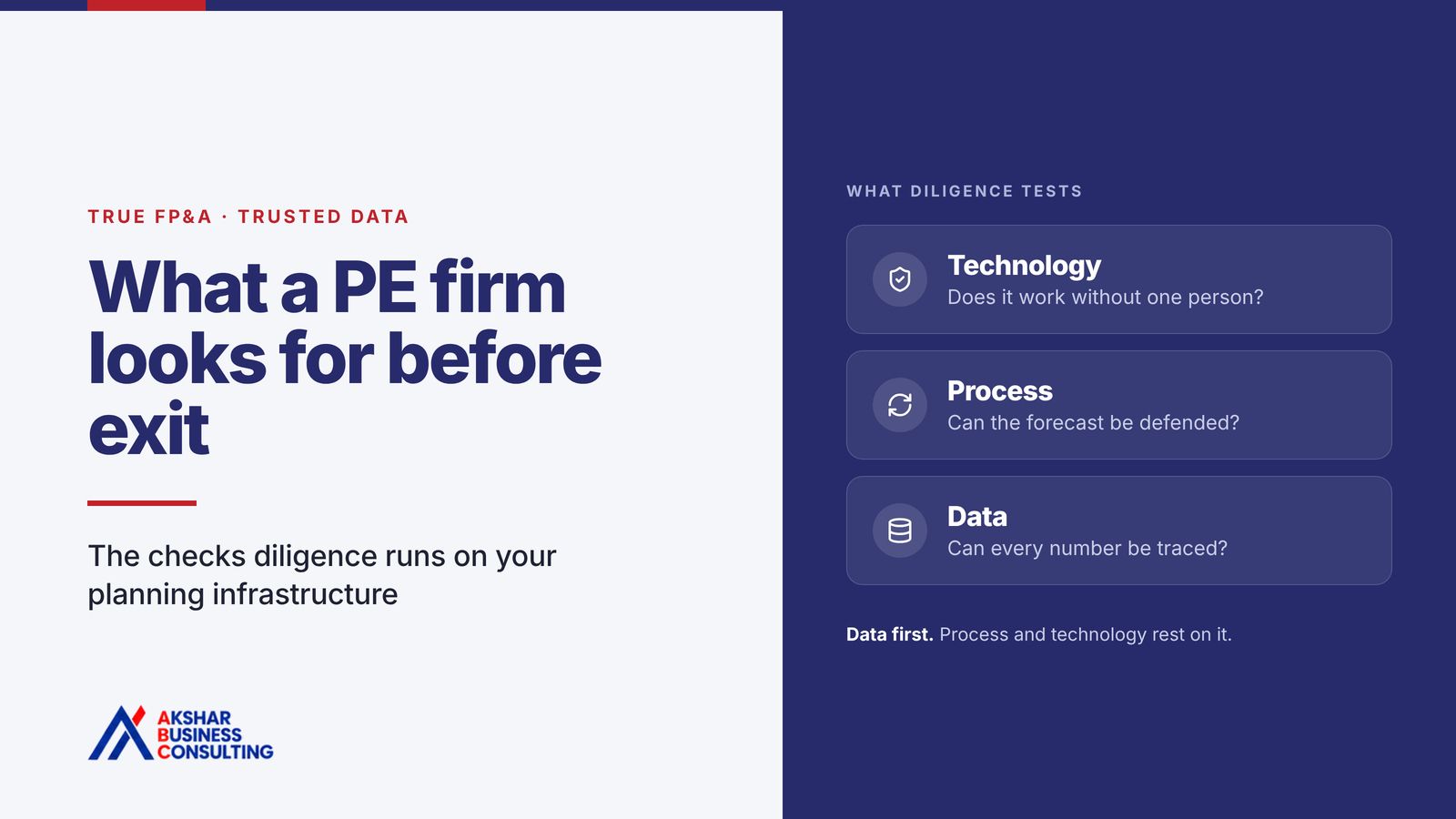
That is when a business learns that exit readiness is not only about the numbers. Diligence tests the machinery that produced them: the data underneath, the process that turns it into a forecast, and the technology that holds it together.
I wrote about the human side of a sale process in Two Thousand Questions, the story of a six-person finance team facing nineteen bids. This piece is the other half: a checklist view of the planning infrastructure a buyer will test, and what good looks like in each layer.
Why planning infrastructure decides exit readiness
Buyers pay for a forecast they can believe. The EY-Parthenon Global PE Exit Readiness Study 2026, a survey of 100 private equity executives and 100 executives from recently exited portfolio companies, found that developing a robust set of data and KPIs was the top finance-function challenge GPs face before an exit, cited by 60% of them. It also found that 86% of GPs said exit preparation improved their exit valuations.
Our own research points the same way. Twelve of the nineteen finance leaders we interviewed for the 2025 FP&A Reality Gap Report were in PE-backed businesses, where every data-quality failure becomes a threat to exit readiness. The report describes what that costs at exit:
“Diligence exposes what should have been fixed. Definitions do not reconcile. Forecast assumptions cannot be defended. The data room tells a story the board does not want to hear.”
2025 FP&A Reality Gap Report · Akshar Business Consulting
Three layers a buyer will test
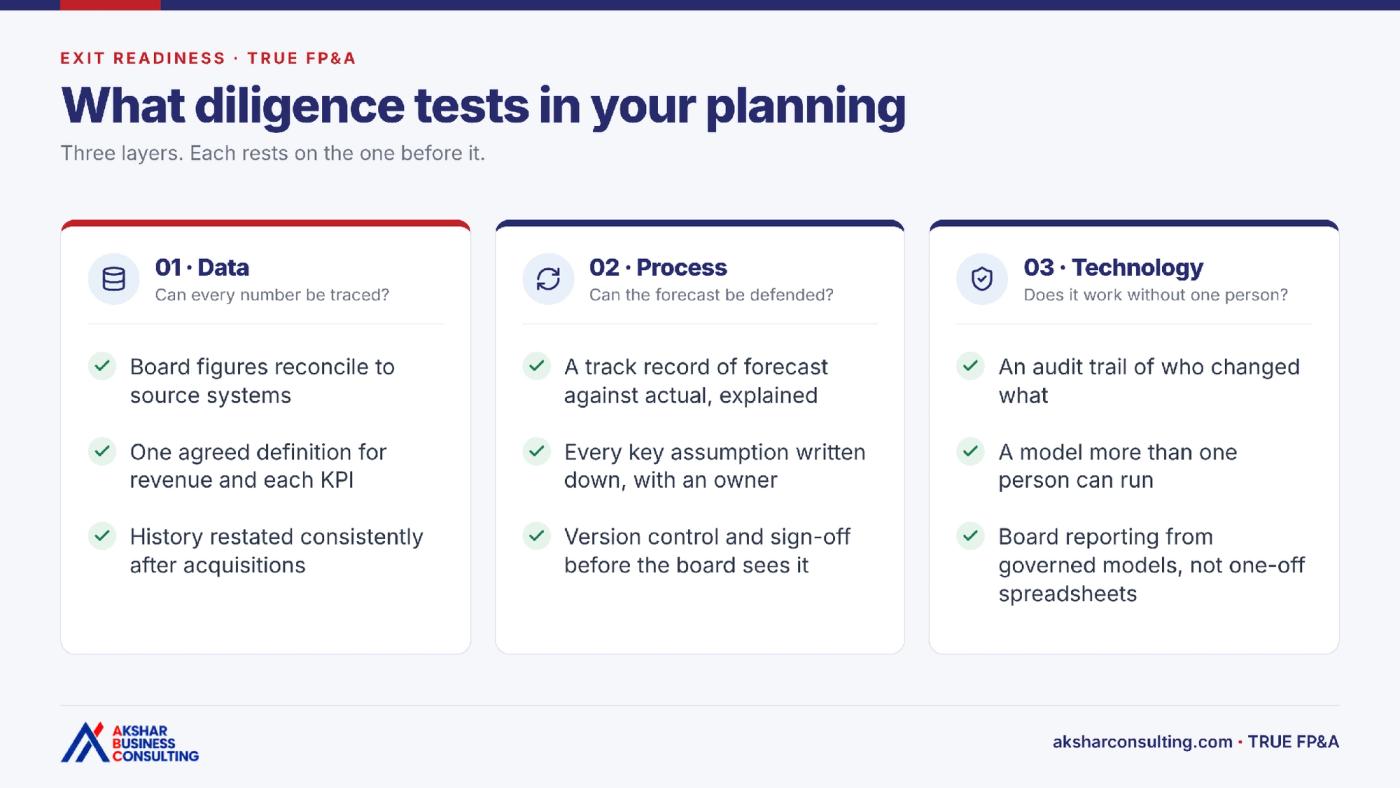
I think of planning infrastructure as three layers: data at the base, process in the middle, technology on top. Most businesses try to fix them in the reverse order.
1. Data: can every number be traced?
A buyer wants to know that the revenue in the board pack, the forecast and the information memorandum is the same revenue, defined the same way, and that it ties back to source. In our research, 15 of the 19 finance leaders did not have a true single source of truth. In ordinary months that gap is manageable. In diligence, every inconsistency becomes a question.
What to check
- Key board figures reconcile to source systems, with adjustments visible rather than buried
- Revenue and each headline KPI have one written definition and a named owner
- History is restated consistently, so an acquisition or a system change does not break the trend
The last point matters most in buy-and-build, where every acquisition arrives with its own version of a metric. In one technology and managed services group we worked with during an ownership transition, questions about outstanding invoices, managed-service customers and implementation profitability took days, sometimes weeks, to answer. Connecting the data, and stating plainly which records were excluded and why, helped ease the investors' initial scepticism. As the case study puts it:
“Credible analysis is not analysis with no gaps. It is analysis where the team can show what the numbers mean, what supports them and where judgement or further work is still required.”
Technology and managed services case study · Akshar Business Consulting
2. Process: can the forecast be defended?
The management case is only as credible as the forecasts that came before it. Advisers will compare what you said would happen with what did, and ask why the two differ. A business that can show a run of forecasts against actuals, with variances explained, is in a very different position from one that rebuilds its forecast from scratch each quarter.
What to check
- A record of forecast against actual over recent quarters, with the main variances explained
- Every key assumption written down, with an owner and a date it was last reviewed
- Version control and sign-off, so you can show which forecast the board approved and when
- The ability to answer a buyer's what-if without rebuilding the model
That last check is where many models fail. Only 2 of the 19 leaders in our research were using genuinely driver-based models. If a buyer asks what happens to EBITDA when one large contract slips, a driver-based forecast answers in minutes. A spreadsheet built from last year plus a percentage answers in days.
3. Technology: does it work without one person?
The question is rarely which platform you use. It is whether the model would survive the person who built it leaving, and whether anyone can see what changed and when.
What to check
- An audit trail of changes to the model and to key figures
- Documentation, so more than one person can run and explain the model
- Board and management reporting produced from governed models, not one-off spreadsheets rebuilt each month
- Access controls that match who should change what
One caution. A new planning platform implemented in the months before a process opens adds risk, because the history and track record buyers want to see live in the old one. Fix the data and the process first. I have written more about why the tool is the last decision.
When to start
Earlier than most teams think. The EY-Parthenon study found that businesses starting exit preparation 12 to 24 months before the sale reported the strongest impact, while those starting less than six months out saw materially weaker results. The data room starts forming long before the process opens.
A practical sequence:
- First: list the questions a buyer is likely to ask and trace each one to its source
- Next: agree definitions, fix reconciliations and restate history where needed
- Then: build a forecast track record, the one part you cannot rush
- Last: decide what technology the process needs, and document what you keep
Where this fits in TRUE FP&A
This is mainly Trusted Data: numbers that can be traced, defended and trusted. But a buyer tests all four parts of TRUE FP&A together. Responsive Planning answers their what-ifs, Up-to-date Insights gets the pack out early enough to be challenged, and Engaged Decision Support shows that Finance shaped the decisions behind the numbers.
What I have come to think
A buyer does not expect a business with no gaps. Every finance function has some. What a buyer reacts badly to is a gap Finance did not know about, or could not explain.
So the goal before exit is not perfection. It is a finance team that can show where every number came from, how the forecast was built, and what is still being fixed.
To see where your reporting stands, the Board Pack Health Check gives you ten scored checks on consistency, controls and evidence. It is a practical self-check, not a full due-diligence assessment. To benchmark the wider function, the TRUE FP&A Assessment takes about five minutes. And if an exit is within two years, a Board Readiness Review is a confidential 30-minute conversation about where to start.
Which layer would hold up worst in your business today: the data, the process or the technology?
Frequently asked questions
What does a PE buyer look at in financial due diligence?
Most financial due diligence covers the quality of earnings, working capital, debt and the forecast. Behind each sits the same question: can the numbers be traced and trusted? So buyers test the data, process and technology that produce the figures, not just the figures.
How early should a finance function prepare for exit?
Ideally 12 to 24 months before a sale process opens. That gives time to fix definitions and reconciliations and, most importantly, to build a track record of forecasts against actuals, which cannot be created at the last minute.
What is a forecast track record and why does it matter?
It is the history of what the business forecast and what actually happened, with the differences explained. Buyers use it to judge how far they can rely on the management case. A consistent, explained track record makes the forecast easier to underwrite.