What nineteen finance leaders told us about the state of FP&A in UK mid-market businesses, and why the problem is design, not effort.
Most finance teams I meet are working harder than they have ever worked. Longer month ends, more reporting, more requests from the board and the sponsor. And yet, in the same businesses, trust in the numbers is falling. Board packs arrive with caveats. Forecasts get approved rather than interrogated. Questions in the room go unanswered until next week.
That contradiction is not an effort problem. You cannot fix it by working harder, because the people involved already are. It is a design problem, and it shows up in remarkably consistent ways.
What the research found
Last year we sat down with nineteen finance leaders in UK mid-market businesses, from £40m to £2bn in revenue, most of them PE-backed. CFOs, Finance Directors, Heads of FP&A. We asked one question: what does your finance function actually look like right now?
We did not arrive with a framework and ask people to agree with it. Four failures came through in nearly every conversation, unprompted. When finance leaders see them named, most recognise all four in their own function.
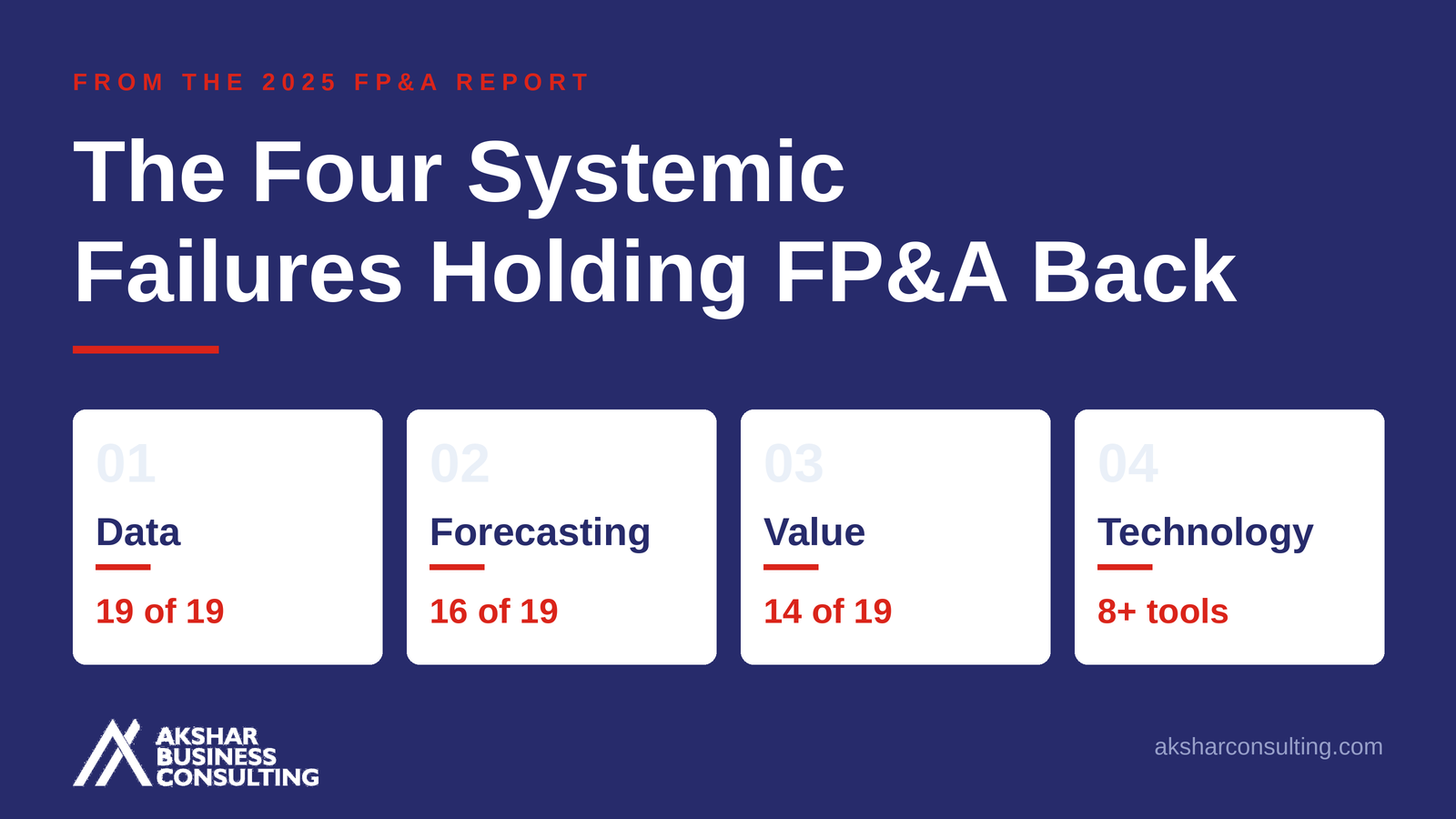
Failure one: the data failure · 19 of 19 raised it, unprompted
Every single interviewee raised data fragmentation, manual reconciliation, or the absence of one clean version of the numbers. Not one had to be asked. It was the most consistent finding in the entire programme.
The symptoms are familiar. Sales, finance and operations pull the same revenue number and get different answers. Board packs carry caveats explaining why this month does not match last. In most mid-market functions, 30 to 60 per cent of FP&A capacity is consumed by manual data work before any analysis begins, and in some businesses it runs above 80 per cent.
One leader traced an 8 to 10 per cent year-end discrepancy to bad data from an HR system. A board-level event, caused by data quality.
A simple question can take one or two days to answer because I have to make multiple calls and manually consolidate across entities. The risk of errors is always there.
Group FP&A leader, 20-entity EMEA business, PE-backed
Failure two: the forecasting failure · 16 of 19 run outdated models
Sixteen of the nineteen were running forecast models built for a world that no longer exists. Pre-COVID assumptions, still in active use. There are no tariff lines in a model built in 2019.
The common pattern is enormous effort producing a single number, with no scenario range, outdated within a month. Several leaders described their forecasts, in their own words, as precisely wrong. Only two of the nineteen were using genuinely driver-based models. The rest could hit a number but could not explain the movement behind it.
In the last four years we’ve had more chaos than in the last 30 to 40 years, and we’ve stayed in the mindset that just predicts an answer. We haven’t moved into scenarios, risks, opportunities.
Group Head of FP&A, global industrial business
Failure three: the value failure · 14 of 19 want to drive, not report
Fourteen of the nineteen said some version of the same thing: too much FP, not enough A. Finance teams stuck producing slides rather than showing what a decision does to cash, capital and return.
What struck me most was the irony underneath it. These leaders are not choosing to report instead of analyse. They are structurally prevented from doing otherwise. The business case for better tools never gets made, because the team has no capacity to make it. The cost centre stays a cost centre.
We sit as finance, interpreting data and doing reporting, rather than influencing decision making. We have slides upon slides rather than a clear view of: if we do this, here’s what it means for cash flow.
Group FP&A Manager, listed leisure and gaming business
Failure four: the technology failure · 8+ tools bought, then unused
Across the cohort we counted more than eight planning platforms and BI tools that had been bought and then quietly abandoned back to Excel. Anaplan purchased and never used for its intended purpose. Power BI licences held for years, untouched. Vena implemented, then dropped.
Here is the uncomfortable part: in almost every case the tool was sound. The implementation was not. Technology without the process and people layer underneath it does not transform anything. It just sits there on the licence bill.
Software just helps you get the wrong answer faster. It exacerbates the bad process.
Alysha Randall, FP&A Unboxed
Why this is a valuation problem, not a finance problem
Twelve of the nineteen businesses in the research are PE-backed, and that is where these failures stop being operational irritations and start costing money. Inaccurate data undermines the investor narrative. A forecast that cannot be interrogated weakens every conversation with the sponsor. A finance function outside the decision cannot defend the value creation plan it is supposed to be tracking.
The four failures compound, and a sponsor sees them even when nobody names them. At exit, they do not price as a to-do list. Weak FP&A becomes a discount, not a multiplier.
What the best teams do differently
The businesses performing well in the research were not using more complex models or more expensive tools. They were designed differently, around four capabilities we call TRUE FP&A: Trusted data, one governed version of performance the CFO can defend. Responsive planning, driver-based models and standing scenarios the board can interrogate. Up-to-date insights, automated flows that give finance its time back for analysis. Engaged decision support, finance embedded in commercial decisions and connecting choices to cash, EBITDA and value.
Each capability answers one of the four failures directly. None of them starts with buying software.
Which failure is costing your function the most?
The fastest way to find out is to see where you stand. The Board Readiness Assessment takes ten questions and about four minutes, and gives you an instant score against the businesses getting this right. If you would rather talk it through, book a Board Readiness Review: thirty minutes with me, confidential, no pitch.
Research from nineteen primary interviews with UK finance leaders, 2025. All interviewees anonymised by role and sector. Read the full 2025 FP&A Report.