Why treating FP&A like a product might be the smartest strategy move you make in 2025
If you walk into a product team’s meeting, you’ll hear terms like user feedback loops, MVPs, iteration cycles, and roadmaps. Step into a marketing team’s brainstorm, and you’ll hear audience insights, conversion journeys, and storytelling frameworks.
Now walk into most FP&A meetings… You’re likely to hear: variance reports, actuals vs budget, forecast updates, and report deadlines.
Useful? Yes. Strategic? Maybe. Influential? Rarely.
Here’s the problem: FP&A teams are still operating like internal service bureaus, not strategic enablers.
And if you want to build a high-impact finance function, it’s time to start thinking like a product or marketing team.
Let’s dive right in to explore what that means for your FP&A function!
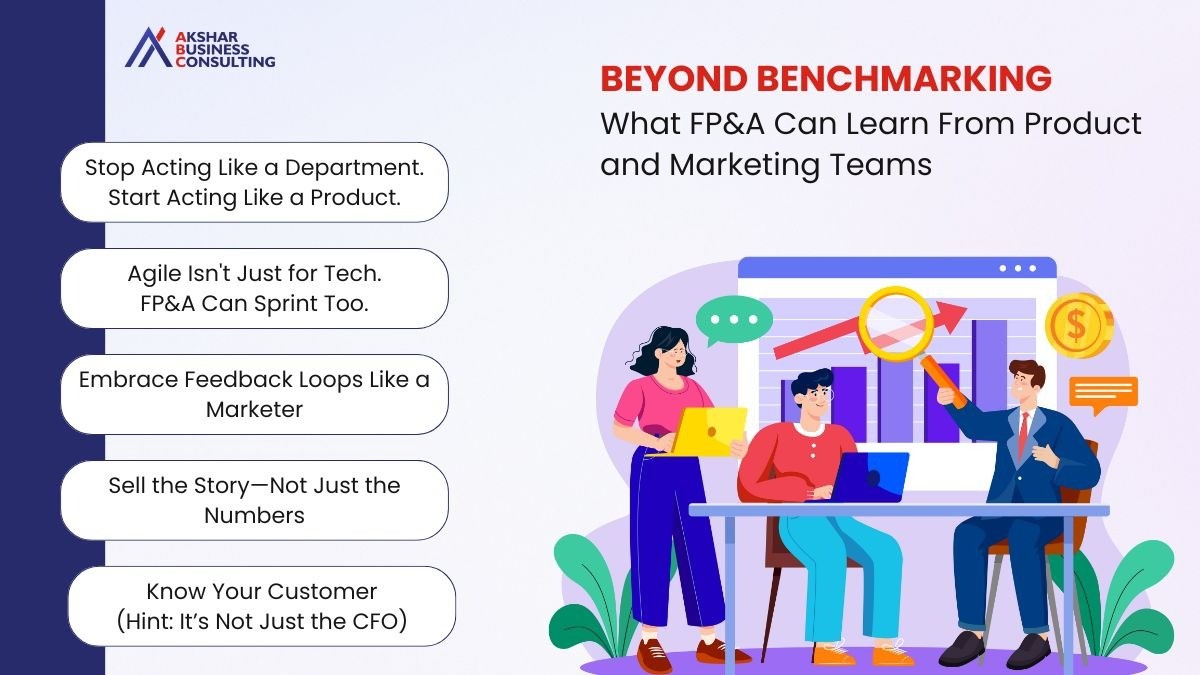
1. Stop Acting Like a Department. Start Acting Like a Product.
Product teams build solutions for people. Marketing teams craft stories for people. But FP&A? Too often, we’re just building reports for compliance.
Instead of asking “Did we send the budget?” Ask: “Did the business actually use it to make a better decision?”
→ If no one’s using what you build, you’re not building—you’re just reporting.
2. Agile Isn’t Just for Tech. FP&A Can Sprint Too.
Product and marketing teams live in sprints. They prioritize experiments, test quickly, fail fast, and adjust.
Why can’t FP&A work the same way?
✅ Instead of building a forecasting model over 6 months, release a rough version in 2 weeks. Get feedback. Add features. ✅ Instead of perfecting dashboards, release MVP versions. Check if stakeholders actually use them.
→ The most valuable FP&A isn’t flawless—it’s fast, flexible, and in flow with the business.
3. Embrace Feedback Loops Like a Marketer
Great marketing isn’t built in isolation. It’s built from audience insight. Yet, many FP&A teams build reports without ever asking:
“Did the CEO find this useful?” “Did the sales head make a different decision because of this analysis?”
📌 Try this:
- Run “FP&A office hours” to gather feedback from internal stakeholders.
- Use feedback forms post-budget cycle.
- Tag your reports with “impact stories”—real actions taken because of your insights.
→ Feedback is your north star. Not accuracy. Not completeness. Not complexity.
4. Sell the Story—Not Just the Numbers
Product teams sell roadmaps. Marketing teams sell narratives. FP&A often just sells spreadsheets.
And that’s a missed opportunity.
If you want your budget proposal approved, your forecast taken seriously, or your scenario plan to shape strategy—learn to frame the narrative.
🧠 A tip from storytelling: Lead with context, not complexity. → “We’re seeing declining margins” is data. → “Our pricing isn’t keeping pace with COGS inflation—especially in product line X, where our margin is down 8% this quarter” is insight.
5. Know Your Customer (Hint: It’s Not Just the CFO)
Marketing teams obsess over personas. They know their ICP’s goals, frustrations, and decision triggers.
FP&A teams? Often, they just send the same report to everyone.
Instead: → Build report formats that suit the COO’s operations lens. → Give marketing a rolling forecast that includes campaign velocity. → Send HR a headcount variance analysis that informs hiring plans.
Final Thought: FP&A Can Be the Product Team of Strategy
The future of FP&A isn’t just about better tools. It’s about better thinking. Better framing. Better empathy. Better engagement.
And that means stealing a page from the product and marketing playbooks.
Because when FP&A stops thinking like a reporting function and starts thinking like a strategic product, it stops reacting to change and starts shaping it.
Which of these 5 product-inspired shifts could transform your FP&A team? Let’s talk in the comments 👇 And if you want to go deeper on this topic and more I’m launching a new podcast series soon, talking to FP&A leaders who’ve built teams like these from the inside. Stay tuned.
📬 Also, don’t forget to subscribe to my newsletter for more fresh perspectives on transforming your finance function.